
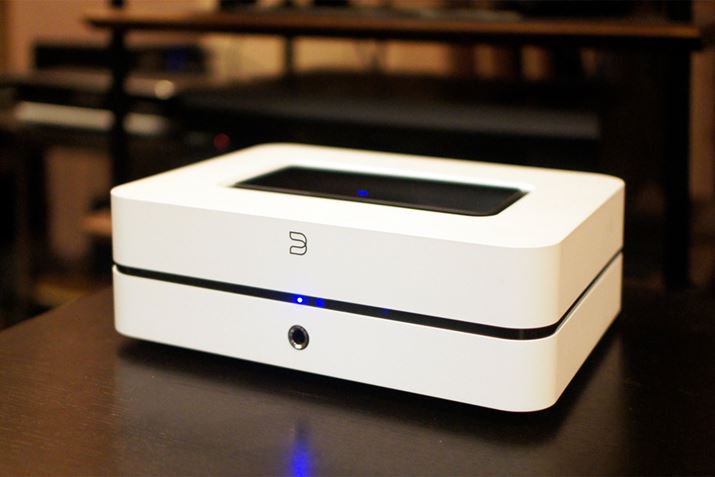
This review covers the POWERNODE (N331) integrated amplifier, which features an HDMI port for connecting to a TV. It's a versatile unit that also supports music streaming services like Spotify, TIDAL, and Qobuz.
When you think of an AV system for enjoying movie sound, you might imagine a setup that includes a player, AV amplifier, and multiple speakers. However, there are probably many people who want to enjoy movies in a simpler way. For those people, we recommend the "POWERNODE (N331)" from Bluesound.
This is an unusual integrated amplifier with a built-in 3-channel amplifier and an HDMI terminal for connecting to a TV . With a TV, the "POWERNODE (N331)," and the necessary number of speakers, you can create a simple system that allows you to freely enjoy music and movies. It's a new generation product that is easy to use yet offers great versatility.
While it may not be very well-known in Japan, Bluesound is a Canadian brand that belongs to the same group as audio brands like NAD Electronics and PSB Speakers. Bluesound itself is a young brand that started in 2013, but NAD Electronics and PSB Speakers are established companies that have been around since 1972.
In short, Bluesound is the latest product line produced by a group of engineers with solid audio expertise.
The flagship product is the "NODE" series, which has an appearance that doesn't give the impression of being an "audio product." It is a network audio player that supports the currently mainstream streaming music distribution services. It can be said to be a pioneer in the style of comfortably enjoying a wide range of internet music streaming services with just a simple, small device, without using a PC.
- While maintaining its slim and beautiful style, "NODE" has evolved to keep up with the times, branching out into various styles. Adding to the lineup are the compact "NODE NANO" and the "NODE ICON," which boasts enhanced sound quality and features like an HDMI port, thus expanding into new styles of hi-fi audio.
The "POWERNODE (N331)" introduced here is also a model that follows the "NODE" concept, boasting an "unconventional audio" appearance and multi-functional features suited to the times. It is a network audio player with an integrated power amplifier .
A model called "POWERNODE" has existed for some time, but that one has a built-in 2-channel amplifier. To distinguish it from the new model, it will be called "POWERNODE (N330)" and will be sold alongside it for a while.
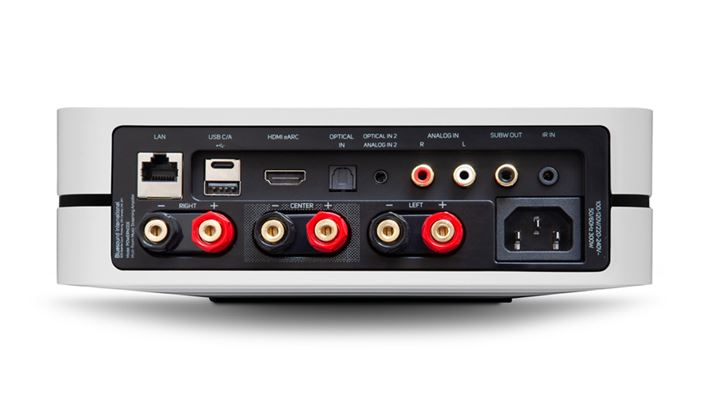
The back panel features three speaker terminals. The most frequently used is the eARC-compatible HDMI terminal. Connecting it to a TV via an HDMI cable allows the audio played on the TV to be output through the amplifier.
The new "POWERNODE (N331)" model features a built-in 3-channel amplifier, and the amplifier itself has been completely redesigned . It incorporates the latest "DirectDigital" platform (digitally input audio is sent to the amplifier section digitally) to improve sound quality. While maintaining its compact body, it delivers 80W x 3 in 3-channel mode and 100W x 2 in 2-channel mode. In addition, the headphone amplifier has been redesigned and incorporates a headphone amplifier with THX-AAA technology. The headphone jack has been changed from a 3.5mm to a standard 6.3mm jack.
Its most notable feature is the inclusion of an eARC-compatible HDMI port in addition to analog audio inputs (RCA) and digital audio inputs (optical). While the concept is that this single unit will complete the entire system, it has more than enough ports for connecting to external devices.
The HDMI port is probably the most important feature. Simply connecting it to a TV (or projector) with an HDMI cable allows for high-quality playback of the TV's audio (volume can be adjusted using the TV remote). The "POWERNODE (N331)" has the feature of supporting Dolby Digital audio decoding, which is where the 3-channel amplifier comes into play. When playing movies on Amazon Prime Video or Netflix, many of them support surround sound such as 5.1ch. It can decode this and enable 3-channel playback (playback with a total of 3 speakers: front L/R speakers and a center speaker placed between them).
Furthermore, by adding (integrating) other products from the same company, it's possible to upgrade to a surround sound system such as 5.1ch (*). This allows you to create a serious AV system for movie playback without using an oversized AV amplifier.
*Compatible products include "POWERNODE (N331)" and "POWERNODE (N330)". Wireless speakers such as "PULSE FLEX 2i" can also be used as surround (rear) speakers.
It's packed with features like music streaming and sound field correction.

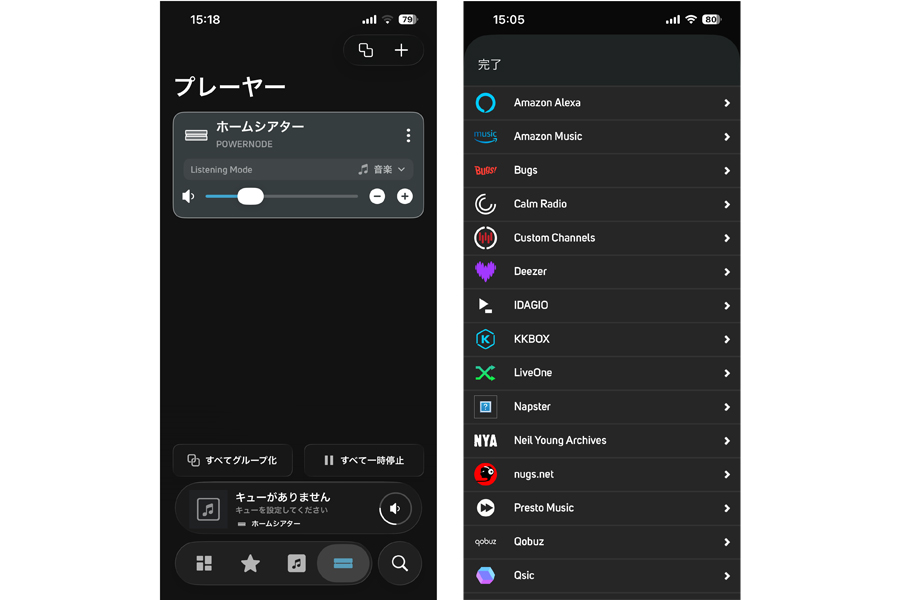
The "BluOS" app allows for basic operations such as volume adjustment, as well as music playback from compatible services. In particular, it supports the "Connect" function for Spotify, Qobuz, and TIDAL. This allows for seamless operation, such as selecting songs in each app and then playing them on the "POWERNODE (N331)".
One notable feature of the "POWERNODE (N331)" is that it runs on a proprietary OS called "BluOS." Thanks to this OS, it achieves a very wide range of functions, including the aforementioned surround sound support, and also supports various music streaming services. Furthermore, it offers paid support for "Dirac Live," which provides high-precision sound field correction (a separate dedicated microphone is also required). Although there is an additional license fee, it can control excessive reflections and standing waves in the room, and the effect is significant. I use "Dirac Live" in my home surround sound system and am satisfied with its effects. Those who are concerned about the acoustics of their room may want to give it a try.
In other words, the foundation for fully enjoying movies and music is so extensive that it's almost obsessive.
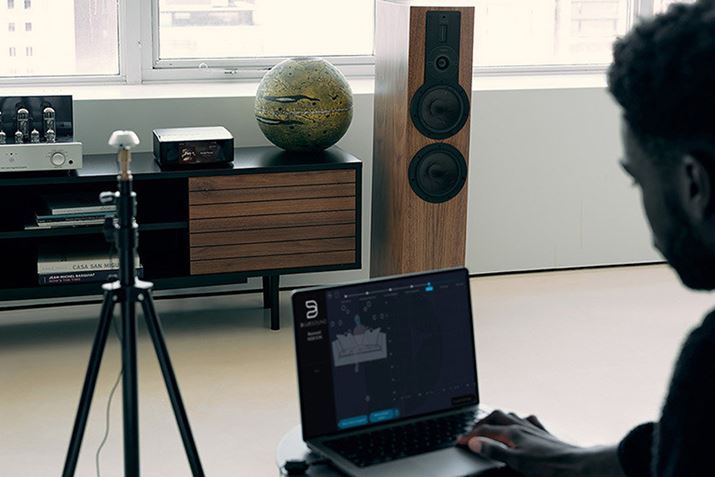
The product is already compatible with "Dirac Live," which was planned to be supported by an update at the time of its release. A separate license and dedicated microphone purchase are required for use.
I was surprised by the power and realistic sound, which are unexpected from such a small amplifier.
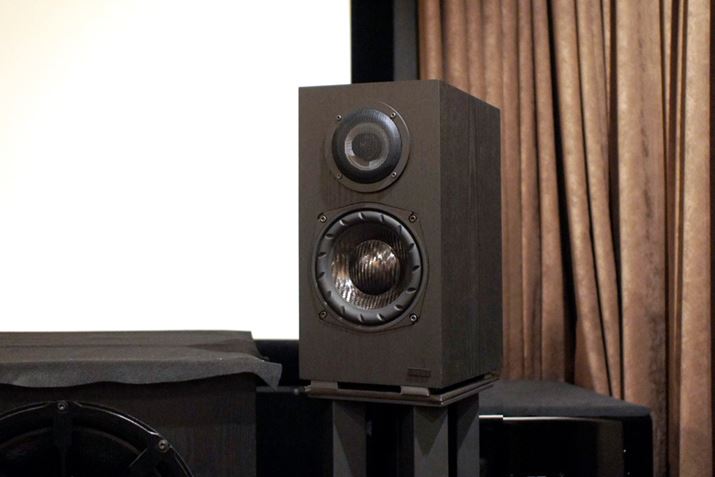
I conducted the test at home. The speaker I used was the BWV "H-2". It's a simple two-way speaker, but the output sound pressure level is relatively low at 81 dB/W/m.
This time, I placed the "POWERNODE (N331)" in my home listening room to test its capabilities. I connected it to my home network and started by playing music from a streaming service.
The service used was Qobuz, which is popular for its lossless audio and high-resolution music streaming. While not as mainstream as Spotify in Japan, it is supported by users who prioritize sound quality. This kind of diverse support is one of the major attractions of "BluOS".
Using various music streaming services is primarily done through the "BluOS" app on your smartphone. For Spotify, Qobuz, and TIDAL, you can also "Connect" from the dedicated apps of each service. For example, if you specify "POWERNODE (N331)" as the playback destination in the Qobuz app, the Qobuz app will issue a command to select a song, and the "POWERNODE (N331)" will start playback (the playback device will be the "POWERNODE (N331)", not the smartphone). This is a convenient function that allows for smoother music playback.

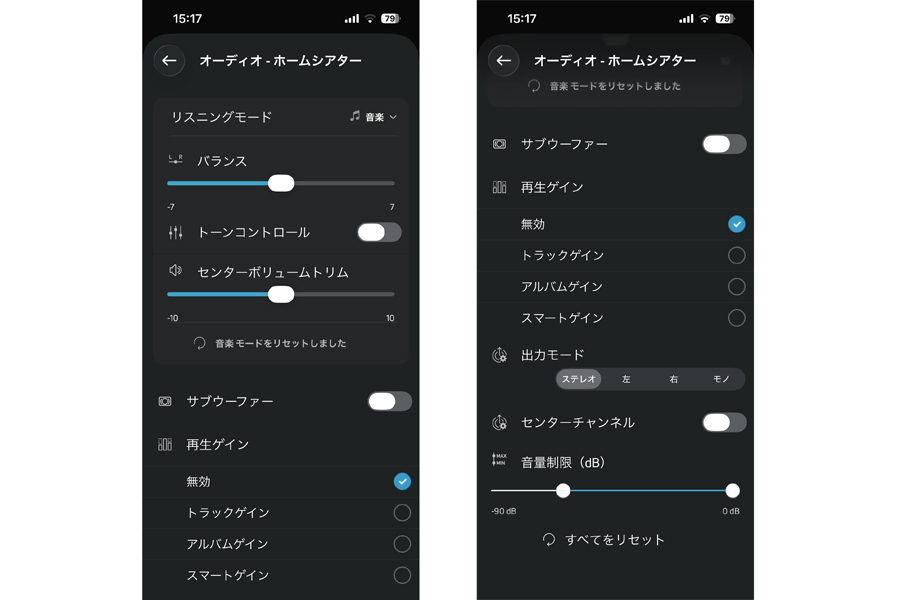
The "BluOS" app also allows you to configure the device settings. You can enable or disable the center speaker and add a subwoofer here.
Here, selecting Qobuz in the "BluOS" app switches to a dedicated Qobuz screen. You can also view playlists and frequently listened-to music, allowing for smooth operation.
When playing the third movement of Tchaikovsky's Symphony No. 6 "Pathetique," conducted by Vladimir Fedoseyev with the Moscow Radio Symphony Orchestra, the sound is incredibly powerful, almost unbelievable considering it's being played through a small amplifier . The string instruments sound natural and realistic. The slightly fast tempo of the performance is reproduced without any loss of momentum. The rapid melodies are rendered with precise tones, and the energy of the bass instruments and percussion is excellent. The rich reverberation of the recording hall and the depth and breadth of the orchestra are also fully present.
The POWERNODE (N331) Class D amplifier not only provides ample output, but also delivers a smooth sound with minimal distortion. Audio enthusiasts will undoubtedly be surprised that such a small enclosure can deliver such impressive power and excellent sound quality.
In King Gnu's "GO GHOST," the opening theme for the TV anime "Ghost in the Shell," the vocals are supple yet clear and resonant. The way the vocals blend with the chorus, which spreads out from left to right, is beautiful, and each voice harmonizes beautifully while remaining distinct and clear.
The headphone output produces a well-balanced, neutral sound.
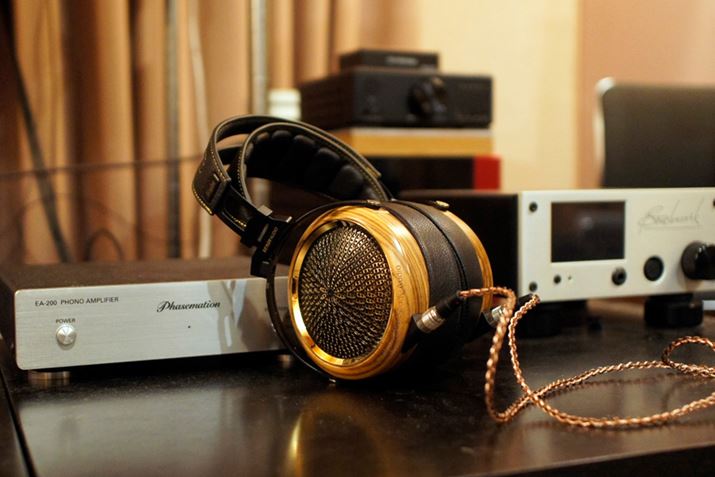
I also checked the headphone amplifier using SENDY AUDIO's "Peacock" (impedance 50Ω, output sound pressure level 103dB/mW).
I also gave the newly redesigned headphone amplifier a quick test. The SENDY AUDIO "Peacock" headphones I connected are planar magnetic and require a bit of driving power, but I have no complaints about the driving power, including the strong bass. The sound quality is neutral, clearly reproducing each note, and the soundstage is sufficiently wide. It's a well-balanced and easy-to-listen-to sound. Some headphone enthusiasts might want a balanced output, but as a headphone output in an integrated system, it has more than enough capability.
The advantage of a center speaker is that it enhances the sense of realism in dialogue and vocals.
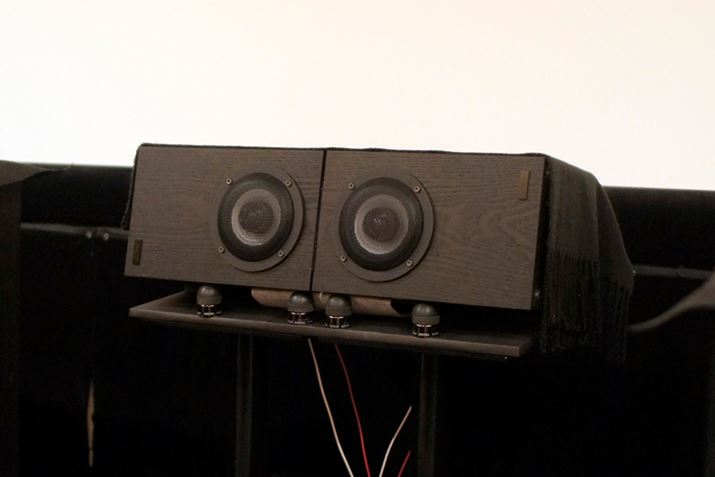
Two BWV "H-1" speakers were connected in parallel to the center speaker. Note that connecting two speakers to the same terminal is not recommended because it puts too much load on the amplifier. The output sound pressure level here is the same as the "H-2," at 81 dB/W/m.
Here, I tried playing in 3-channel mode by adding the center speaker. When playing 2-channel audio sources such as music with the center speaker, you can choose whether to output sound only through the front L/R speakers (2 channels) or to distribute the sound to the center speaker as well. So, I tried the "stereo surround" setting, which outputs sound from the center speaker, and in 2-channel playback, vocals and other sounds that are positioned in the center are automatically distributed to the center speaker. The volume balance also seems to be adjusted automatically.
While the overall balance doesn't change drastically, the addition of a center speaker creates a more tangible sound reproduction, with vocals appearing to come forward. The increased number of speakers also enriches the sound's breadth and depth. Because it delivers rich sound over a wide area, this playback method is well-suited for large living rooms or listening with multiple people.
Of course, if you turn off the "stereo surround" setting, 2-channel audio sources can be played using only the front left and right speakers.
The surround sound in the movie also maintains a high level of quality.
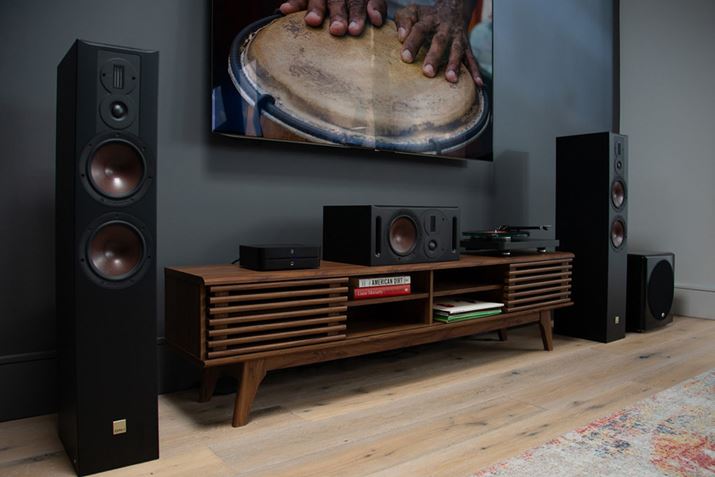
The "POWERNODE (N331)" alone can create a maximum 3.1ch system as shown in the picture. Furthermore, it can be expanded to 5.1ch by adding amplifiers and speakers from the same company.
Furthermore, by connecting it to a TV with an HDMI cable, surround sound playback via HDMI (eARC) is also possible. As mentioned earlier, by grouping the company's products and adding a subwoofer, it can be expanded to a maximum of a 5.1ch system.
Having a center speaker means that important elements in music, such as vocals, and important dialogue in movies, are played through dedicated speakers. This means that the key elements in each case become clearer and more distinct. This benefit is particularly noticeable in movies.
If you have a large room or a large screen (I use a 120-inch screen and projector at home), having a center speaker makes the sound localized in the center of the screen clearer, and you can expect an improved sense of immersion with the image. Therefore, if you want to properly enjoy not only music but also movies, using a 3-channel amplifier with a center speaker offers significant advantages .
The surround sound playback capabilities of the "POWERNODE (N331)" are also impressive. When I experienced the expanded 5.1ch system for another project, it was able to faithfully reproduce the surround sound field of a movie. In addition to converting 2ch audio to 5.1ch and reproducing it with a rich sense of sound field, the volume of the center and surround speakers can be adjusted individually.
It's important to note that this device lacks features like automatic sound field adjustment found in AV receivers, and its functionality is minimal, requiring users to input the measured distance from the listening point to the speakers. Conversely, this means you can easily enjoy high-quality surround sound without having to fine-tune the settings. If you simply want to enjoy movies casually, many people will likely find it easy to use.
While it doesn't support the latest immersive audio technologies like Dolby Atmos, its 5.1ch surround sound capabilities, which are supported by many movies, are more than sufficient. For a system aiming for simplicity, like the "POWERNODE (N331)," this should be perfectly adequate.
[Summary] "POWERNODE" is a new style of audio equipment that combines ease of use with high-quality sound.
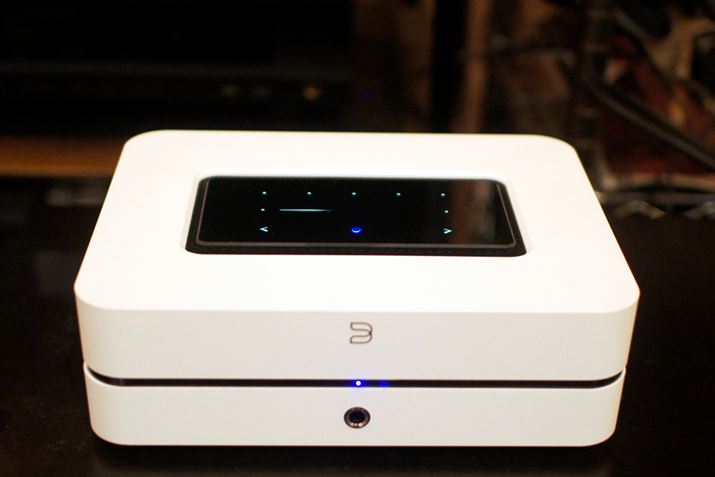
Input switching and volume adjustment can be done using the buttons on the top.
The POWERNODE (N331) is not only a highly capable audio product, but it's also slim, compact, and extremely feature-rich . With this unit (and your favorite speakers), you can enjoy a wide variety of music streaming services, and it also has the potential to connect to a TV (or projector) via HDMI (eARC) to enjoy audio from video streaming services in 3-channel or 5.1-channel surround sound. The sound quality is also excellent.
I'm truly impressed by the level of functionality it has achieved. It's a new style of audio equipment that's perfect for people who want to enjoy music and movies casually yet seriously . For those who want to avoid the typical look and bulky casing of audio equipment, the modern design of the "POWERNODE (N331)" will be very appealing.


0 Comments